<?xml version="1.0" encoding="UTF-8"?>
<feed xmlns="http://www.w3.org/2005/Atom">
  <title type="text">Project Des Moines</title>
  <updated>2026-04-17T19:40:25+00:00</updated>
  <generator uri="http://framework.zend.com" version="1.12.20">Zend_Feed_Writer</generator>
  <link rel="alternate" type="text/html" href="https://projectdesmoines.curatescape4.reclaim.hosting/"/>
  <link rel="self" type="application/atom+xml" href="https://projectdesmoines.curatescape4.reclaim.hosting/items/browse?output=rss2"/>
  <id>https://projectdesmoines.curatescape4.reclaim.hosting/</id>
  <author>
    <name>Project Des Moines</name>
    <uri>https://projectdesmoines.curatescape4.reclaim.hosting</uri>
  </author>
  <link rel="hub" href="https://pubsubhubbub.appspot.com/"/>
  <entry>
    <title type="html"><![CDATA[Amend&#039;s Meats]]></title>
    <summary type="html"><![CDATA[<img src="https://projectdesmoines.curatescape4.reclaim.hosting/files/fullsize/b83a11857367692afa9bf05b351d31e6.jpg" alt="Amend&#039;s Meats" /><br/><p> Amend’s high quality meat has been a culinary treat for the city of Des Moines since founder Conrad Amend opened his first meat market four years after the Civil War. Amend was 11 years old when, alone, he left Germany to seek his fame and fortune in the New World. He arrived in New York on the 11th of September, 1860 where he remained for one year.</p><p>He then worked in an apothecary in Buffalo, NY and then a farm and a meat market near there. After working for six years, Amend left to seek his fortune farther west with $50 in his pocket and a change of clothes.</p><p>Conrad opened his first shop in Des Moines in 1869. It was located at Second and Vine streets, but his main base of operations ended up being a three-story building that he built at Third and Walnut. Cattle were harvested behind the downtown building, sausage was made on the second floor and poultry was processed on the third floor. For over 50 years that building housed the Amend operation.</p><p>Conrad had a very large family with two daughters and nine sons. In 1908, the Amend sons joined the business, and with the help of William, John, George, Edward, Gus, Herman, Albert, Arthur and Ralph, C. Amend & Sons was born. The third generation of Amend men, Ralph Jr. and Richard carried on the meat processing business operating a packing plant, while Edward Jr. ran a retail store in Beaverdale.</p><p>The packing plant, known as Amend Packing Company moved to their current headquarters on S.E. 18th Street in 1928. Kent and Amy (fourth generation) continue the family operation.</p><p><em><strong><a href="https://projectdesmoines.curatescape4.reclaim.hosting/items/show/55">For more (including 8 images) view the original article</a></strong></em></p>]]></summary>
    <published>2021-02-08T17:57:51+00:00</published>
    <updated>2026-04-17T19:40:25+00:00</updated>
    <link rel="alternate" type="text/html" href="https://projectdesmoines.curatescape4.reclaim.hosting/items/show/55"/>
    <id>https://projectdesmoines.curatescape4.reclaim.hosting/items/show/55</id>
    <author>
      <name>Amy Amend Wiese &amp;amp; Amend Packing Co.</name>
    </author>
  </entry>
  <entry>
    <title type="html"><![CDATA[Union Park]]></title>
    <summary type="html"><![CDATA[<img src="https://projectdesmoines.curatescape4.reclaim.hosting/files/fullsize/6b753c3ea231eb24940eeaa755a4b9cc.jpg" alt="Entrance, Union Park" /><br/><p>Union Park was established in 1894 as one of Des Moines’s first parks. Originally comprised of 27 acres, the park boasted an aviary, pavilion, stone fountain, and greenhouse when it first opened. </p><p>Prior to becoming a park, the land was part of the Thompson estate and held the first frame house erected in Polk County. The Thompson Homestead was built in the 1840s by Andrew Thompson and would eventually be painted by American Gothic artist Grant Wood in the 1920s not long before it was torn down.</p><p>Union Park has grown over the years, eventually expanding to 51 acres and adding notable features like the Rocket Slide in the 1970s and the Heritage Carousel in 1998. Today the park includes a formal gardens, playground, tennis and basketball courts, and much more.</p><p><em><strong><a href="https://projectdesmoines.curatescape4.reclaim.hosting/items/show/62">For more (including 13 images) view the original article</a></strong></em></p>]]></summary>
    <published>2021-11-16T18:39:55+00:00</published>
    <updated>2026-04-17T19:40:25+00:00</updated>
    <link rel="alternate" type="text/html" href="https://projectdesmoines.curatescape4.reclaim.hosting/items/show/62"/>
    <id>https://projectdesmoines.curatescape4.reclaim.hosting/items/show/62</id>
    <author>
      <name>Des Moines Parks &amp;amp; Recreation</name>
    </author>
  </entry>
  <entry>
    <title type="html"><![CDATA[Seni-Om-Sed]]></title>
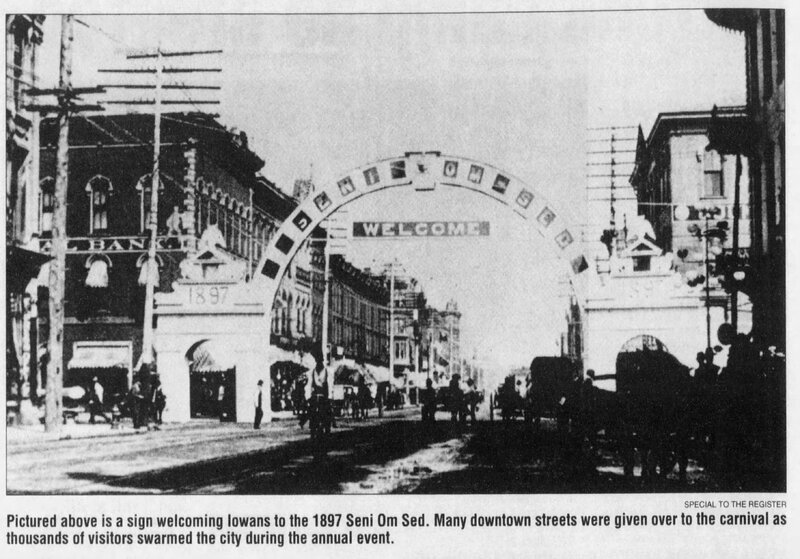
    <summary type="html"><![CDATA[<p><strong><em>Des Moines used to host one of the most exciting festivals in the Midwest, a carnival of Marde Gras-esque proportions. </em></strong></p><img src="https://projectdesmoines.curatescape4.reclaim.hosting/files/fullsize/7e748a6d268e04081a35c032da1051ff.jpg" alt="[Untitled]" /><br/><p>Those of you who’ve lived here a little while will recognize the name Seniom-Sed but the name actually goes back way earlier than most people know.  </p><p>Seni-Om-Sed used to be one of the biggest parties around. People would come from all over Iowa to attend the festivities. The festival started in conjunction with the State Fair. At the time the fair was entirely agricultural, without all the entertainment options that are part of it now. After the sun went down, so did the fair. So the Des Moines Commerce Exchange (what is now the Greater Des Moines Partnership) founded a festival to take place during the fair. This would happen both at night and during the day. They created a fictional king called King Seni-Om-Sed to rule over the proceedings. There were daily parades and massive fireworks exhibitions at night. And people came in droves. The 1890 festival drew a little over 85,000 people.  </p><p>What began in cooperation with the state fair quickly turned into a competition. The fair had moved to its current location on the east side and Seni-Om-Sed became the West side’s festival. There were angry allegations that one side of the river was giving more to the festivities.  There was a call to do separate activities on either side of the river, which thankfully didn’t pass. The problem quickly became that some of the parades held during the day, were pulling crowds away from the fair. It was struggling.  In response, the fair started adding new entertainment. They contracted with one of the pyrotechnic companies that had done some of the Seni-Om-Sed displays to put on ones at the fairgrounds instead. In 1898 the Paine Pyrotechnics company put on The Battle of Manilla at Seni-Om-Sed. Two years later they were putting on gigantic displays for the Fairgrounds. In many ways the competition made the fair what it is today. The parade is a direct offshoot of the various parades that were part of the festival. </p><p>That said it was still a citywide event. Advertisements in the paper were calling for all houses on the parade routes to decorate. Businesses were quick to capitalize on the need and offer their services. The event shut down a large section of the downtown area, and included the creation of a large welcome gate. Both Walnut and Locust were closed. The parades, often several over the course of the week, ran for a mile to two miles through the city.  </p><p>There are a few notable stories that have come out of Seni-Om-Sed.  </p><p>William Morrison’s electric car </p><p>The first electric car was invented here in Des Moines and debuted at a Seni-Om-Sed parade in 1890. Invented by William Morrison the car could run for 100 miles on a single charge. Morrison was a battery inventor and mostly focused on those, but he knew that he needed to provide people with an example of what the batteries could do. Morrison’s car used 24 batteries hidden under the seats. It had a top speed of about 8 miles per hour. For most Des Moineans, this would be the first horseless carriage they would see.  </p><p>Handy the Elephant </p><p>There was an elephant in Davenport. It had been given to the Davenport Malting Company to settle a claim it had against a traveling circus. I want to know more about this story. The elephant lived large on beer and liver sausage. It carried materials for the brewers that would injure the horses or mules that worked there. It was lent to the carnival in 1898 by the brewing company and arrived by train to great fanfare. It was there to lead the Burlesque parade. It sadly didn’t get the same fare as at home, having to make do with water and hay. It’s unknown what happened to Handy after the carnival. It's thought it returned to Davenport to finish the rest of its days at the brewery.  </p><p>Vicksburg Extravaganza </p><p>One of the major events that occurred with the carnival were the fireworks displays at night put on by the Paine Pyrotechnic Company out of Chicago. I had mentioned the one earlier that was meant to showcase the Battle of Manilla. That drew tens of thousands and included not only fireworks but costumed soldiers as well and ships. The whole extravaganza cost $5,000 in 1890 money. That works out to about $155,000 in today’s money. In 1897 the carnival put on a show to imitate the Siege of Vicksburg. About 60,000 attended, in comparison to the State Fair, which only drew 20,000 that day. The siege took place on the river and included boats, and  </p><p>Revival </p><p>In 1979 the Des Moines Jaycees started offering an after work party downtown at Nollen Plaza and they reclaimed the name with a twist. This was Seniom Sed, to differentiate it from the earlier festival. The Friday night beer and music fest ran from 1979 to 2002 during the summer months. At times it would bring up to 2,000 to 3,000 people to the plaza. Generally described as a meat market it was well attended by young professionals who worked downtown. It was so successful that the suburbs decided to create their own. By 2002, festivals like Clive after 5 and Function in the Junction were bringing people to the suburbs instead. At the end there were only 100 or so people attending and the festival was shut down.  </p><p>Interested in the name? For those of you who haven’t guessed, it’s Des Moines spelled backwards.  </p><p><em><strong><a href="https://projectdesmoines.curatescape4.reclaim.hosting/items/show/68">For more (including 7 images) view the original article</a></strong></em></p>]]></summary>
    <published>2023-01-06T17:50:41+00:00</published>
    <updated>2026-04-17T19:40:25+00:00</updated>
    <link rel="alternate" type="text/html" href="https://projectdesmoines.curatescape4.reclaim.hosting/items/show/68"/>
    <id>https://projectdesmoines.curatescape4.reclaim.hosting/items/show/68</id>
    <author>
      <name>Des Moines Public Library</name>
    </author>
  </entry>
  <entry>
    <title type="html"><![CDATA[Baker Barb Wire vs. Knights of Labor]]></title>
    <summary type="html"><![CDATA[<img src="https://projectdesmoines.curatescape4.reclaim.hosting/files/fullsize/d1eed6725706d839c93ea0210b7392cd.jpg" alt="Baker Wire Co." /><br/><p>George C. Baker of Polk City, Iowa, invented Baker Barbed Wire, manufactured it in Des Moines, and before too long it was the world’s largest manufacturer of barbed wire. </p><p><a href="http://npshistory.com/brochures/home/barbed-wire.pdf" target="_blank" rel="noreferrer noopener">Barbed wire</a> was a significant revolution for farmers. Prior to the use of barbed wire, fences were made from hand split oak rails or by trimming an Osage Orange hedge. But certainly the contribution of barbed wire to American agriculture is most noticeable in the open prairie ranges of the west.The lifestyle of the cowboy was ended by barbed wire.</p><p>The Baker Wire Company covered the whole square block from First and Second and from Vine to Market. The company operated 20 barbing machines for 10 hours a day, 6 days a week. They paid the laborers $1.50 a day. The first real labor dispute in Des Moines occurred at the Baker Wire plant. </p><p>In the 1870’s the concept of labor unions were spreading around the country. One such union was the <a href="https://www.khanacademy.org/humanities/us-history/the-gilded-age/gilded-age/a/the-knights-of-labor" target="_blank" rel="noreferrer noopener">Knights of Labor</a>. Baker Wire let the employees know that this was something they were not to become involved with. However, they did, and when they showed up for work on Monday morning after a meeting they were fired. </p><p>The Knights of Labor rose to the defense of the workers, solicited the support of the farmers' <a href="https://www.history.com/this-day-in-history/oliver-kelley-organizes-the-grange" target="_blank" rel="noreferrer noopener">Grange,</a> and created a boycott of Baker wire. After a couple of months the dealers of Baker Wire started shipping the barbed wire back because no one would buy it. The company reconsidered its position, restored the men to their jobs, and business resumed. Baker Wire Company was eventually sold and moved out of the state.</p><p><em><strong><a href="https://projectdesmoines.curatescape4.reclaim.hosting/items/show/61">For more (including 5 images) view the original article</a></strong></em></p>]]></summary>
    <published>2021-06-11T19:13:30+00:00</published>
    <updated>2026-04-17T19:40:25+00:00</updated>
    <link rel="alternate" type="text/html" href="https://projectdesmoines.curatescape4.reclaim.hosting/items/show/61"/>
    <id>https://projectdesmoines.curatescape4.reclaim.hosting/items/show/61</id>
    <author>
      <name>DMPL Staff</name>
    </author>
  </entry>
  <entry>
    <title type="html"><![CDATA[Jewett Typewriter Company]]></title>
    <summary type="html"><![CDATA[<img src="https://projectdesmoines.curatescape4.reclaim.hosting/files/fullsize/a860016c4670d94c2e6cb689c8a6fbfc.jpg" alt="Jewett Typewriter Company" /><br/><p>Many people in the Des Moines area associate the Jewett name with Gilcrest Jewett Lumber, but George Jewett, a founding partner, had many other interests. In 1872, he helped found the Iowa Loan & Trust Co and before that, organized Des Moines Scale Co. He was a founder of Drake University and assisted in organizing the YMCA. But in 1888, an invention grabbed his attention: the <a target="_blank" href="https://site.xavier.edu/polt/typewriters/duplex.html" rel="noreferrer noopener">typewriter</a>. </p><p>The Jewett Typewriter Company sold one of the first commercially successful machines worldwide. According to the Des Moines Register, Jewett visited Europe 10 times to promote his typewriter business and his company received awards at the Chicago World’s Fair and the Paris Exposition. It was reported that the Kaiser Wilhelm of Germany owned one and the Bank of England used it when it switched from longhand. </p><p>The company began at 608 Locust but in 1906 moved to a three-story building on 3rd Street next door to Harbach Undertaking. This building was previously the Continental Biscuit Company.</p><p>Unfortunately, Jewett Typewriter had some challenges in the early 1900s, as some stockholders out East wanted to move the factory to Cleveland. Jewett Typewriter managed to hold out until about 1910 when it was purchased by <span><a href="https://americanhistory.si.edu/collections/search/object/nmah_998196">Underwood Typewriter Company</a></span> and fully ceased production in Iowa.</p><p><em><strong><a href="https://projectdesmoines.curatescape4.reclaim.hosting/items/show/1">For more (including 5 images) view the original article</a></strong></em></p>]]></summary>
    <published>2019-07-26T17:39:59+00:00</published>
    <updated>2026-04-17T19:40:25+00:00</updated>
    <link rel="alternate" type="text/html" href="https://projectdesmoines.curatescape4.reclaim.hosting/items/show/1"/>
    <id>https://projectdesmoines.curatescape4.reclaim.hosting/items/show/1</id>
    <author>
      <name>DMPL Team</name>
    </author>
  </entry>
  <entry>
    <title type="html"><![CDATA[Harbach Lofts]]></title>
    <summary type="html"><![CDATA[<img src="https://projectdesmoines.curatescape4.reclaim.hosting/files/fullsize/286c906c744a54ac1443a9c92ce3a830.jpg" alt="Harbach Furniture Factory and Warehouse" /><br/><p>The history of Harbach Lofts began more than 100 years ago with the beginning of Harbach Furniture. As shown in the National Register of Historic Places documentation, the Harbach family made significant contributions to the city of Des Moines, and the former Harbach Furniture complex indicates the family’s business success.
At age 19, Louis Harbach began as a harness maker in Des Moines while his brother Christopher ran a small furniture shop on 2<sup>nd</sup> Street. Louis took a break from Des Moines and traveled to Cincinnati to learn cabinet making.  When he returned, he and his brother opened a furniture shop together and expanded operations. Over the years, the business gained financial success, expanded, and moved its base of operations several times. In 1882, Harbach furniture had grown from a workshop of a few people building everything by hand into a furniture factory employing 150 people using machinery. Historian Jennifer James documents Harbach’s success and the importance of his contributions business-wise and architecturally in her National Register of Historic Places application for the Harbach Lofts at 300 SW 5th Street.
<em>The L. Harbach's Sons Co. and predecessor Harbach family firms including L. Harbach & Sons Co. manufactured furniture for more than seventy years in Des Moines and occupied this factory complex from 1906 to 1928. These large industrial buildings allowed the company to upgrade its manufacturing to early twentieth-century modern factory conditions to remain competitive in a changing marketplace. The warehouse allowed the company to accommodate stored materials as well as associated handling equipment in tandem with the rail line behind its complex. The Warehouse and Factory Complex also represents some of the earliest and largest industrial construction in Des Moines' then-newly emerging warehouse and jobbing district south of the major rail lines-an important real estate development, and one of the last major such real estate development projects undertaken by the L. Harbach & Sons Co. and its founder, Louis Harbach. Louis Harbach was noted during his lifetime as an important real estate developer in Des Moines who "set the pace" innovatively, building the first furniture factory in Des Moines; constructing the first four-, five-, and six-story retail commercial buildings in the city; continuing to improve his commercial buildings; and erecting the first building dedicated exclusively to mortuary purposes in the city (completed in 1916) - all of these buildings are non-extant, which raise the importance of these two rare surviving functionally related factory and warehouse buildings. (Des Moines Daily News, August 30, 1898; Halstead: 34) –</em> Jennifer James National Register of Historic Places document.
You may read the full history of The Harbach Lofts and more about the Harbach family in Jennifer James’ National Register of Historic Places <a target="_blank" href="https://www.nps.gov/nr/feature/places/pdfs/15000918.pdf" rel="noreferrer noopener">application</a>.</p><p><em><strong><a href="https://projectdesmoines.curatescape4.reclaim.hosting/items/show/2">For more (including 8 images) view the original article</a></strong></em></p>]]></summary>
    <published>2019-07-26T18:47:39+00:00</published>
    <updated>2026-04-17T19:40:25+00:00</updated>
    <link rel="alternate" type="text/html" href="https://projectdesmoines.curatescape4.reclaim.hosting/items/show/2"/>
    <id>https://projectdesmoines.curatescape4.reclaim.hosting/items/show/2</id>
    <author>
      <name>DMPL Team</name>
    </author>
  </entry>
  <entry>
    <title type="html"><![CDATA[Younkers Department Store: An Iowa Icon Timeline]]></title>
    <summary type="html"><![CDATA[<img src="https://projectdesmoines.curatescape4.reclaim.hosting/files/fullsize/cc94cf6c9c1b8811c091e95ac1cba44b.jpg" alt="Younker Brothers Department Store" /><br/><p>1854 - Teenagers Marcus, Lipman, and Samuel Younker move to the United States from Lipno, Poland.</p><p>1856 – Lipman, Samuel, and Marcus Younker establish the first Younker & Brothers Dry Goods Store in Keokuk, Iowa. 
1874 – A younger brother, <a href="https://books.google.com/books?id=G8RFAQAAMAAJ&pg=PA20&lpg=PA20&dq=norman+younker+des+moines&source=bl&ots=Jk2oRCGUU2&sig=ACfU3U2eTF-DI8zYLtMjLNMoVtABJi48Yw&hl=en&sa=X&ved=2ahUKEwiz36Ob_sXhAhXrna0KHQfWDGsQ6AEwEnoECAcQAQ#v=onepage&q=norman%20younker%20des%20moines&f=false" target="_blank" rel="noreferrer noopener">Herman</a>, opens the Younker Dry Goods Store in Des Moines.
1879 – The Keokuk store closes and the Des Moines store becomes the headquarters for Younker Brothers.
1881 – Younker Brothers hires Mrs. Mary McCann, the first woman to be employed by any store in Des Moines.
1899 – The Des Moines store moves to its long-term location at Seventh and Walnut Streets, opening on November 9.</p><p>1910 - Younker Brothers employs over 500 men and women.
1912 – Younker Brothers purchases the Grand Department Store.
1913 – The original Tea Room opens.
1927 – The new Tea Room replaces the old.
1927 – The company merges with Harris-Emery Company and becomes the largest department store chain in Iowa.
1928 – Younker Brothers buys J. Mandlebaum and Sons.
1936 – Air-conditioning comes to the entire downtown store.
1939 – A modernization program includes the installation of the first “electric stairs” (escalators) in Iowa. Thousands turn out to try the new invention.
1943 – Younker Brothers purchases the seven-story building across the street from the main store and opens the Store for Homes. A tunnel under the street connects the two stores.
1956 – Younker Brothers negotiates to buy the site of St. Gabriel’s monastery on Merle Hay Road. This later becomes the site of Merle Hay Mall.
1959 – Younker Brothers Merle Hay Mall store opens.
1950s-1960s – Younker Brothers opens several more Des Moines stores as well as branches in Sioux City, Iowa City, Oskaloosa, Ottumwa, Omaha, Nebraska, and Austin, Minnesota.
1978 – Tragedy strikes when the Merle Hay store is destroyed by a <a href="https://www.desmoinesregister.com/story/news/2014/03/29/younkers-fire-1978-merle-hall-mall-deadly/7056287/" target="_blank" rel="noreferrer noopener">fire</a> which kills ten employees.
1979 – Equitable of Iowa purchases Younker Brothers for $72.2 million and makes the retailer a subsidiary officially named Younkers.
1985 – The downtown Store for Homes closes.
1986 – Younkers purchases major competitor Brandeis & Sons, which has eleven department stores in Iowa and Nebraska.
1992 – Younkers purchases the department store division of H.C. Prange Co., a privately owned chain with twenty-five stores.
1994 – Milwaukee-based retailer Carson Pirie Scott & Co. makes an unsolicited bid for Younkers, but the Younkers board votes not to sell.
1995 – Younkers accepts a bid for the company of $216 million from Proffitt’s, Inc., a Tennessee chain.
1998 – Proffitt’s buys Saks Fifth Avenue and makes Younkers a division of Saks.
2005 – The flagship downtown store closes on August 12, ending more than 100 years of retailing on the same site. A store-closing sale brings thousands of people downtown to purchase memorabilia ranging from teacups from the fabled Younkers Tea Room to the “Electric Stairs” sign which had hung over the escalators since 1939. It was the end of an era for downtown retailing in Des Moines.
2006 - Bon-Ton Stores acquires from Saks all the shares of its Northern Department Stores Group, and becomes the new corporate parent of Younkers.</p><p>2007 - Downtown Sioux City store, a presence since 1948, closes.
2007 - Store furnishings and memorabilia from the downtown Des Moines store are sold at a liquidation event in May.
2013 - Wisconsin-based Alexander Co begins renovation work on the Des Moines flagship building in September; plans are for retail on the first two floors and apartments above.
2014 - The downtown Des Moines building is gutted by <a href="https://www.kcci.com/article/downtown-younkers-building-burns-1/6890749#" target="_blank" rel="noreferrer noopener">fire</a> on March 29; its cause is eventually ruled “undetermined.”
2018 - Last Younkers stores <a href="https://www.desmoinesregister.com/story/money/business/2018/04/18/younkers-bon-ton-close-sale-bankruptcy-stores-iowa-shopping-retail-amazon-going-out-business/528308002/" target="_blank" rel="noreferrer noopener">close</a> August 29.
2018 - Indiana-based CSC Generation buys the Younkers name in September and launches a new website.</p><p><em><strong><a href="https://projectdesmoines.curatescape4.reclaim.hosting/items/show/3">For more (including 6 images) view the original article</a></strong></em></p>]]></summary>
    <published>2019-07-29T20:59:59+00:00</published>
    <updated>2026-04-17T19:40:25+00:00</updated>
    <link rel="alternate" type="text/html" href="https://projectdesmoines.curatescape4.reclaim.hosting/items/show/3"/>
    <id>https://projectdesmoines.curatescape4.reclaim.hosting/items/show/3</id>
    <author>
      <name>DMPL Team</name>
    </author>
  </entry>
  <entry>
    <title type="html"><![CDATA[General Crocker Steamer]]></title>
    <summary type="html"><![CDATA[<img src="https://projectdesmoines.curatescape4.reclaim.hosting/files/fullsize/d8e383293678cae04c41c1653cc1fea4.jpg" alt="General Crocker Steamer" /><br/><p>In the summer of 1869 the first fire engine arrived in Des Moines: It was named the General Crocker Steamer in honor of General Marcellus Crocker, beloved Des Moines lawyer who died at the end of the Civil War. The steamer was financed by the Hawkeye Insurance Company, which only fought fires carrying the insurance company plaque on the building. The organization of a paid city fire department didn’t occur until March of 1882.</p><p><em><strong><a href="https://projectdesmoines.curatescape4.reclaim.hosting/items/show/4">For more (including 2 images) view the original article</a></strong></em></p>]]></summary>
    <published>2019-08-01T17:39:38+00:00</published>
    <updated>2026-04-17T19:40:25+00:00</updated>
    <link rel="alternate" type="text/html" href="https://projectdesmoines.curatescape4.reclaim.hosting/items/show/4"/>
    <id>https://projectdesmoines.curatescape4.reclaim.hosting/items/show/4</id>
    <author>
      <name>DMPL Team</name>
    </author>
  </entry>
  <entry>
    <title type="html"><![CDATA[Demoine House]]></title>
    <summary type="html"><![CDATA[<img src="https://projectdesmoines.curatescape4.reclaim.hosting/files/fullsize/a1111a85c4b72635d642ab93c379684c.jpg" alt="Demoine House" /><br/><p>A fashionable hotel known as the Demoine House once stood at First and Walnut Streets, which is now where the Polk County Office building resides. John Yost and Martin Tucker opened the Demoine House in April 1855, and it soon became the site of elegant parties for city residents and lodging for visitors. Part of the building was completed by covering some of the vacated barracks from the old fort.
Not long after the DeMoine House opened, Colonel Sumner Spoffard (not officially a colonel) purchased it and ran it himself until 1862. Lorenzo F. Andrews writes, “it was a lively place. The bar-room annex on the south side was the rendezvous for politicians. There being no public hall, the dining-room was a favorite place for dancing parties, where, in the pale mellow light of tallow dips or whale oil, joy went unconfined.”
When the state capital was moved to Des Moines, many people working in government stayed at the Demoine House, as well as those traveling through. Mildred Throne cites:
<em>The space between the river and the capitol was a muddy swamp… But the people of Des Moines tried to make up for the shortcomings of their little town by lavish hospitality – at least as lavish as the frontier could afford. On the west side, at the “only hotel of much pretentions” – the DeMoine House. There Governor Grimes had rooms, and Ralph P. Lowe awaited his inauguration, and the “soft coal stoves glowed with a red heat.”</em>
When Governor Grimes held his victory reception for U.S. Senate in January of 1858, it was at the Demoine House. Throne mentions it as “the famous hostelry” and Governor Grimes dressed the part, which many found surprising:
<em>One of the great levees given at the famous hostelry (Demoine House) was that given by Governor Grimes in honor of his election as United States senator. The Governor was never noted for the tidiness of his wearing apparel, and was often seen trudging from the DeMoine House over to the Capitol Building through the mud, generally with his pants stuck in his boot tops, or else one leg in the boot top and the other rolled up, while the rest of his dress was worn in a don't-care sort of manner—in fact it was on the slouchy order…  But when the guests—the members of the legislative, the state officers, judges of the Supreme Court and leading citizens began to arrive they found a great surprise awaiting them, for there stood the senator elect clothed in a spick-and-span new full dress suit, patent leather shoes and kid gloves. This little incident furnished food for talk for the frontier town for many months. The old settlers even say that it was one of the grandest soirees ever given in the city.</em>
Senator-elect Grimes said there were 178 guests and all his rivals were there and they enjoyed a “harmonious, well-conducted, sumptuous feast.”
Many other parties were held there, including one on Washington’s birthday in 1858 that had live music and dancing until 3 AM. The pioneers knew how to throw a party. The DeMoine house continued operating until 1877 when the building was pulled down. It was to be replaced with the Spofford but money became scarce, and it was never finished. Eventually, the property was deeded to Uncle Sam for a new post office in a deal negotiated by Louis Harbach.</p><p><em><strong><a href="https://projectdesmoines.curatescape4.reclaim.hosting/items/show/5">For more view the original article</a></strong></em></p>]]></summary>
    <published>2019-08-06T17:43:05+00:00</published>
    <updated>2026-04-17T19:40:25+00:00</updated>
    <link rel="alternate" type="text/html" href="https://projectdesmoines.curatescape4.reclaim.hosting/items/show/5"/>
    <id>https://projectdesmoines.curatescape4.reclaim.hosting/items/show/5</id>
    <author>
      <name>DMPL Team</name>
    </author>
  </entry>
  <entry>
    <title type="html"><![CDATA[Romano Fruit Stand]]></title>
    <summary type="html"><![CDATA[<img src="https://projectdesmoines.curatescape4.reclaim.hosting/files/fullsize/d6457d9db8aa22116140b5ac64cfbc4b.jpg" alt="Egidio Romano and Fruit Stand" /><br/><p>According to a Des Moines Register article, Egidio Romano came to Des Moines from Italy by way of Omaha, Kansas City, and then St. Paul.  Romano started his fruit stand in Des Moines in 1891 and eventually became the Secretary-Treasurer of the Italian Importing Company, a wholesale grocery. His fruit stand snuggled up under the staircase to a drugstore at 221 5th Street on what was the Harbach Block.</p><p><em><strong><a href="https://projectdesmoines.curatescape4.reclaim.hosting/items/show/6">For more (including 5 images) view the original article</a></strong></em></p>]]></summary>
    <published>2019-08-06T20:48:40+00:00</published>
    <updated>2026-04-17T19:40:25+00:00</updated>
    <link rel="alternate" type="text/html" href="https://projectdesmoines.curatescape4.reclaim.hosting/items/show/6"/>
    <id>https://projectdesmoines.curatescape4.reclaim.hosting/items/show/6</id>
    <author>
      <name>DMPL Team</name>
    </author>
  </entry>
</feed>
