<?xml version="1.0" encoding="UTF-8"?>
<feed xmlns="http://www.w3.org/2005/Atom">
  <title type="text">Project Des Moines</title>
  <updated>2026-04-17T19:40:25+00:00</updated>
  <generator uri="http://framework.zend.com" version="1.12.20">Zend_Feed_Writer</generator>
  <link rel="alternate" type="text/html" href="https://projectdesmoines.curatescape4.reclaim.hosting/"/>
  <link rel="self" type="application/atom+xml" href="https://projectdesmoines.curatescape4.reclaim.hosting/items/browse?output=rss2"/>
  <id>https://projectdesmoines.curatescape4.reclaim.hosting/</id>
  <author>
    <name>Project Des Moines</name>
    <uri>https://projectdesmoines.curatescape4.reclaim.hosting</uri>
  </author>
  <link rel="hub" href="https://pubsubhubbub.appspot.com/"/>
  <entry>
    <title type="html"><![CDATA[The University of Lawsonomy]]></title>
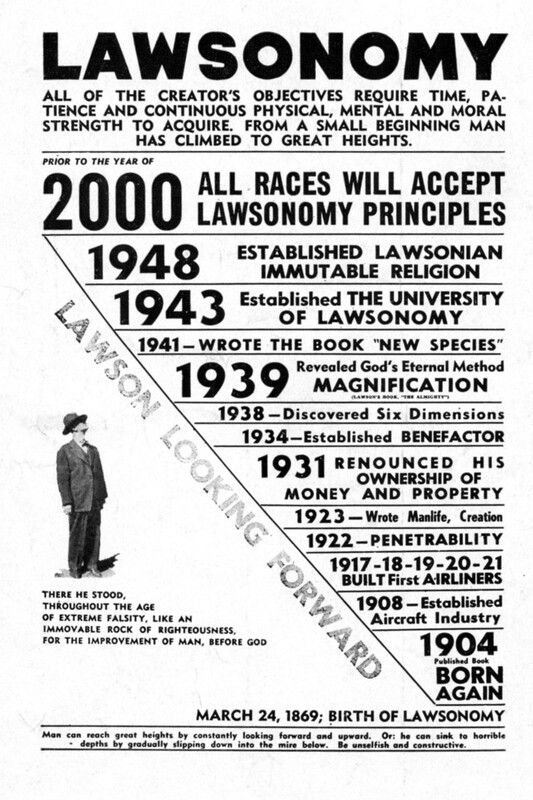
    <summary type="html"><![CDATA[<p><strong><em>The story of Alfred Lawson's utopian, non-profit university is one of the stranger episodes in the history of the Midwest.  </em></strong></p><img src="https://projectdesmoines.curatescape4.reclaim.hosting/files/fullsize/bdc74f02f1c741f74d7cefede91d8cbf.jpg" alt="Lawsonomy poster, circa 1950" /><br/><p>	In 1943, Alfred Lawson, former professional baseball player, manager, and owner, aviation pioneer, and more recently economic philosopher, purchased the six buildings and 14 acre grounds of the former University of Des Moines campus (closed since 1929) for $80,000.  The newly created University of Lawsonomy opened that fall with 70 students, who grew vegetables (part of the Lawsonian philosophy was a vegetarian diet, often eaten raw), and studied a curriculum based on the works of Alfred Lawson (around 50 books and numerous articles and pamphlets), covering subjects such as physiology, metaphysics, spirituality, theology, health, physics, economics, and the history of aircraft.  A degree certifying the holder as a ‘knowlegian’ could take 30 years or more to achieve.  </p><p>Who was Alfred Lawson?  That is a question with many answers.  He was born in London, England in 1869, and was first noted as a promising minor-league baseball player in the United States in the 1880s.  However, his first (and only) major-league season as a pitcher in 1890 ended quickly and ignominiously with no wins and no hits.  With this end to his career as a player, he moved into managing teams and players, assembling teams that played in Cuba, Europe, and Australia.  Eventually he owned some of these teams himself, which gave him the room to try some new ideas of his own.  During the early 1900s, he experimented with various innovations, trying out electric lights for night games and scheduling games between white teams and black teams.  </p><p>However, by the late 1900s his fertile imagination had been captured by something else: powered flight.  In 1908 he founded a magazine titled “Fly” – the first magazine devoted specifically to airplanes.  He later changed the title to “Aircraft”, and in fact this coined the word.  He became a pioneer in aviation himself, eventually designing and building what some argue was the first passenger airplane in 1919 and popularizing the word ‘airline’.  His airliner carried 18 people, had a projector onboard to show in-flight movies, and made a flight from Milwaukee to Chicago to a farm outside of Toledo and to Cleveland, then on to Buffalo, New York City, and Washington, D.C.  Perhaps because of a few crash landings on this initial journey, and the fact that his next (26 passenger) airliner crashed on its very first test flight in 1921, Lawson Airlines never really took off, and went bankrupt by 1922.  </p><p>After this disappointment, Lawson began to write more about his ideas and philosophies, starting with a book titled “Manlife” in 1923.  This and many other later books and articles received only minor interest until 1931, when the Great Depression brought attention to his economic philosophies.  Lawson declared he would spend the rest of his life propertyless and moneyless. He started the Direct Credits Society in 1931, publishing his own newspaper and pamphlets, and two years later it was among the more popular movements in the country, especially in the Midwest.  Thousands attended his speeches in Detroit and Chicago in the mid-1930s, despite them not being publicized in any mainstream media, and Lawson’s followers staged parades complete with marching bands, specially written songs, and snappy white uniforms.  The slogan of his Direct Credits Society was “Justice for Everybody Harms Nobody”, and his opposition to interest charges certainly had great appeal during the hardest years of the Depression – even if much of the rest of his writings and speeches were obscure and difficult to understand, including his ideas about good and evil microbes he called ‘menorgs’ and ‘disorgs’, the principles of zig-zag-and-swirl, discussions of six dimensions, and the ‘Law of Penetrability’.  </p><p>When the United States entered World War II, however, Lawson’s utopian sentiments and bizarre ideas lost appeal rapidly.  In 1943, when Lawson University opened its doors, he had only 70 students – a far cry from the thousands of followers he had led just a few years earlier (though he would still claim to have 2000 students).  In 1948, the tax assessor of Des Moines inspected the site and concluded that it was “a university in name only” and was better described as “a colony for a community within the community for the purpose of eulogizing Alfred Lawson”.  In the aftermath of WWII, Lawson also took the opportunity offered to educational institutions to buy up war surplus machine tools.  However, instead of using them for educational purposes, he ran a discreet side hustle selling some of this equipment off to private buyers within the US. This, of course, was not an activity allowed for a non-profit university who had been sold government property for pennies on the dollar, expecting it to be used for training students.  In 1952, this resulted in the now almost completely delusional Alfred Lawson being brought before a US Senate Investigative Committee where instead of protesting his innocence or seeking a plea deal, he used his time before the senators to try to explain Lawsonian religion and philosophy to them. They reacted with a mixture of amusement and irritation, and had the IRS revoke the nonprofit status given the university by the state, demanding it pay back taxes.  In response, Lawson closed the school.  Shortly thereafter, in 1954, Alfred Lawson died.  </p><p>A few years later, in 1957, a former student and follower named Merle Hayden reopened the University of Lawsonomy on a farm outside Racine, Wisconsin.  This property had previously been the University of Lawsonomy Farm, and now formed the whole of the campus.  The university operated in this location with no tuition or fees (and very few students) until 2017, when Merle Hayden, the last Lawsonian, died.  </p><p>The Des Moines site of the University of Lawsonomy, at 2nd and Euclid in Highland Park, is now occupied by the Park Fair Mall.  </p><p><em><strong><a href="https://projectdesmoines.curatescape4.reclaim.hosting/items/show/67">For more (including 7 images) view the original article</a></strong></em></p>]]></summary>
    <published>2022-07-14T16:54:58+00:00</published>
    <updated>2026-04-17T19:40:25+00:00</updated>
    <link rel="alternate" type="text/html" href="https://projectdesmoines.curatescape4.reclaim.hosting/items/show/67"/>
    <id>https://projectdesmoines.curatescape4.reclaim.hosting/items/show/67</id>
    <author>
      <name>DMPL Team</name>
    </author>
  </entry>
  <entry>
    <title type="html"><![CDATA[Old Des Moines U.]]></title>
    <summary type="html"><![CDATA[<img src="https://projectdesmoines.curatescape4.reclaim.hosting/files/fullsize/032817fcaf93d1773694eb657332d223.jpg" alt="Des Moines College" /><br/><p>Second and Euclid is the home of Park Fair Mall, but it was once the site of an interesting piece of Des Moines educational history. Highland Park College, Des Moines University, and the University of Lawsonomy once stood on this spot.
Highland Park College was established here in 1889 and operated under that name until 1918, when the Baptist church bought it and renamed it Des Moines University. The school had some 40,000 students and 1,000 pharmacy graduates in its first twenty-five years. Trouble began when a fundamentalist group known as the Baptist Bible Union of North America took over the school in 1927. The administration required all faculty members to agree to eighteen articles of faith. Many faculty members objected to this, and several of them left the university and joined Carl Weeks (later founder of the <a href="https://cosmeticsandskin.com/companies/armand.php" target="_blank" rel="noreferrer noopener">Armand Cosmetic Company</a>) in forming Des Moines College of Pharmacy in downtown Des Moines. All but two of the pharmacy students at the university left to enroll in the new school.
At the same time that faculty were being required to agree to the articles of faith, students were also having many restrictions placed upon them. It is reported that three girls were disciplined for doing cartwheels during a vaudeville skit. General unhappiness spread and things came to a head when board chairman Thomas T. Shields fired the entire faculty on May 11, 1929. A few hours later a riot broke out among the students. Angry students marched on the administration building in the afternoon, and that night 150 students attacked the building where the board of trustees was meeting. They threw eggs and rocks and attempted to break down the door to the room where the board members were hiding. Eventually, police drove the students from the building, but not before they had wrecked the front office of the school administration building. The school closed in September 1929, and the buildings remained empty until the third, and even stranger chapter of the area’s history began.
In 1943, <a href="https://archive.org/search.php?query=%28%28subject%3A%22Lawson%2C%20Alfred%20William%22%20OR%20subject%3A%22Lawson%2C%20Alfred%20W.%22%20OR%20subject%3A%22Lawson%2C%20A.%20W.%22%20OR%20subject%3A%22Alfred%20William%20Lawson%22%20OR%20subject%3A%22Alfred%20W.%20Lawson%22%20OR%20subject%3A%22A.%20W.%20Lawson%22%20OR%20subject%3A%22Lawson%2C%20Alfred%22%20OR%20subject%3A%22Alfred%20Lawson%22%20OR%20creator%3A%22Alfred%20William%20Lawson%22%20OR%20creator%3A%22Alfred%20W.%20Lawson%22%20OR%20creator%3A%22A.%20W.%20Lawson%22%20OR%20creator%3A%22A.%20William%20Lawson%22%20OR%20creator%3A%22Lawson%2C%20Alfred%20William%22%20OR%20creator%3A%22Lawson%2C%20Alfred%20W.%22%20OR%20creator%3A%22Lawson%2C%20A.%20W.%22%20OR%20creator%3A%22Lawson%2C%20A.%20William%22%20OR%20creator%3A%22Alfred%20Lawson%22%20OR%20creator%3A%22Lawson%2C%20Alfred%22%20OR%20title%3A%22Alfred%20William%20Lawson%22%20OR%20title%3A%22Alfred%20W.%20Lawson%22%20OR%20title%3A%22A.%20W.%20Lawson%22%20OR%20title%3A%22Alfred%20Lawson%22%20OR%20description%3A%22Alfred%20William%20Lawson%22%20OR%20description%3A%22Alfred%20W.%20Lawson%22%20OR%20description%3A%22A.%20W.%20Lawson%22%20OR%20description%3A%22Lawson%2C%20Alfred%20William%22%20OR%20description%3A%22Lawson%2C%20Alfred%20W.%22%20OR%20description%3A%22Alfred%20Lawson%22%20OR%20description%3A%22Lawson%2C%20Alfred%22%29%20OR%20%28%221869-1954%22%20AND%20Lawson%29%29%20AND%20%28-mediatype:software%29" target="_blank" rel="noreferrer noopener">Alfred W. Lawson</a> of Detroit bought the property and founded the Des Moines University of Lawsonomy. Early in his career, Lawson was involved in the aviation industry. By the time he came to Des Moines, he was promoting Lawsonomy, sweepingly billed as “the study of everything.” It was said that students (men only) would be required to study for thirty years to achieve the degree of “Knowledgian.” Lawsonomy was based on forty-seven principles based on books written by Lawson, and the curriculum of the school consisted largely of memorizing Lawson’s books. Enrollment at the school was as much as 100 at one time but dwindled gradually to fewer than twenty by the time the university closed in 1954. The property was sold to developer Frank A. DePuydt for $250,000, and Lawson died two weeks later on November 29, 1954. DePuydt built the Park Fair Shopping Mall on the site, and a chapter of Des Moines' educational history came to an end.</p><p><em><strong><a href="https://projectdesmoines.curatescape4.reclaim.hosting/items/show/25">For more (including 6 images) view the original article</a></strong></em></p>]]></summary>
    <published>2020-01-06T21:49:58+00:00</published>
    <updated>2026-04-17T19:40:25+00:00</updated>
    <link rel="alternate" type="text/html" href="https://projectdesmoines.curatescape4.reclaim.hosting/items/show/25"/>
    <id>https://projectdesmoines.curatescape4.reclaim.hosting/items/show/25</id>
    <author>
      <name>DMPL Team</name>
    </author>
  </entry>
</feed>
