History of the Rowat Cut Stone Co.
Text
A history of the Rowat Cut Stone Company should begin many years back. In fact, in 1850 a boy was born into a large family in Kilmarnock, Scotland. This boy started to learn to be a stonecutter at the age of 14 and just after he was 21 years old he left Liverpool, England to come to the United States. This boy was John Rowat, father of Thomas W. Rowat. The craftsmen of those days were quite strong for their Fraternal organizations. John was a stonemason, so he along with two other men had been taking the Masonic degrees and were all given the third degree in Masonry at Liverpool just the day before they sailed for America. John Rowat went to Chicago when he arrived in America and worked around there for a short time. When he heard that a State Capitol building was being built in Iowa, he came to Des Moines in 1872 and got work as a stonecutter on the Capitol building. In those days they did not seem to be in such a rush as they are now, which shows up in the fact that they spent more than 12 years in building our State Capitol. This job was built before any modern machinery had been introduced in the stone business. Every stone was quarried out for a certain place in the building and brought here by freight and was cut by hand right on the job. All the stone cutting was done by piece work. They were paid so much for top or bottom beds by the square foot and so much for bevels. The whole Capitol building was built by day labor; that is, the legislature would appropriate, perhaps $400,000 or 800,000, for a two year period to proceed with the building. As soon as the legislature had made the biennial appropriation they would build up the crew on the job and then towards the end of the two year period they would be low on money and the crew would be reduced to a minimum. Then after the legislature met and appropriated more money the whole crew would go back to work. At times there were 125 stone cutters working the job. A Mr. Finkbine was the Superintendent in charge of construction and was a wonderfully capable man. There was never even the suggestion of graft at any time during the construction of this building. After the completion of the Capitol building, John Rowat decided to go into the stone business here in Des Moines. Probably the main reason for this decision was that he had married Mary Thomas, a young school teacher about 4 years before that. She had been teaching school in the East Des Moines public schools and taught at Bryant school. Father got a lot of counsel and good advice from his father-in-law John Thomas, a pioneer blacksmith who came to Des Moines in 1859. From the early record it is amazing to find that the first year John Rowat was in business he used 23 carloads of stone. One of his early entries in his record books represents his beginning... “Bought 2 pinch bars of cast steel $4.80”. This was his first equipment. Lots of his early work consisted of furnishing large pieces of flagstone for sidewalks, most of them 6” thick. Some other entries are as follows:
-
- Hauled stone to Dr. Dickinson’s on 4th St.: $10.00
- Sand to lay flagstone, 3 loads @ 60 cts: 1.80
- Paid cash to help lay flagstone: 8.70
- Paid cash to help unload car of stone: 1.50
- Paid freight on care of stone from Joliet: 35.00
About 1920 brother Fred came into the business and together we struggled through this period of growing pains and finally came out with quite a stone plant. We also had a fine crew of about 50 men. From 1919 to 1929 things were booming and we went along working practically every day during this period. In 1917 we had the Cottage Grove Church, in 1918 the Northwestern Hotel and the Savery Hotel. Then we got into the big school program with Roosevelt and Lincoln High going at the same time. On those jobs I remember we had over a mile of certain moulding to plane out. Then we had a bunch of churches like Plymouth Congregational and Grace Methodist. Both of these jobs have some fine stone work on the entrances. Also, the Monastery, which has recently been torn down for the Merle Hay Plaza Shopping Center, on which we had considerable work, the Insurance Exchange Building, the Scottish Rite Consistory Building and the Federal Court Building. About that time the stock market crash came along and sales dropped off until they were 92% off of a 10 year average. Our crew disappeared and even our key men had to go on unemployment compensation.
Around 1940 we had work on the Bankers Life Building and the addition in 1959, the Iowa Power and Light Building later on, as well as the Central Life Assurance Building and the First Baptist Church.
Quite an eventful thing happened in the period from 1920-1930. About 1922 we did the stone work on the Carl Weeks residence. Carl and his wife Edith, were world travelers. They wanted to build a home in Des Moines and in all their travels they finally picked out a home in Salisbury, England that they wanted to duplicate. Carl had talked to me about it and had shown me pictures. I had gathered up samples of different kinds of stone that they might use, but we could not figure out exactly what stone to use to get the effect he wanted. He always said from the start “ If this house doesn’t look 100 years old the day it is finished we have failed”. On his next trip to Europe, as he was thinking over his plans, he said to his wife “I think if Tom Rowat could see Salisbury Place he might be able to tell us what stone we could use to get the effect we want”. He wired back to the
Armand Company, his place of business, “Have Tom meet us in Salisbury on December 28th". They called me from the Armand Co. on a Thursday and I was on the train Monday starting for England. They gave me $500.00 for my expenses, but before I was back home I had spent about $500.00 more on the trip. I got my passport started in Des Moines and went to the State Department in Washington, DC to finish it up to save time. Then I went to New York and while there called on Mr. Rasmussen who was the New York architect on the job. Carl sent Mr. Rasmussen over to Salisbury to measure up the job and make preliminary sketches on the house a couple of years before this. Just the year before, he had sent Ben Boyd of the firm of Boyd & Moore over to look over the job. They were the Des Moines architects. I met Mr. & Mrs. Weeks in Salisbury on December 28th and spent several days going over the house and also going around with them and his antique dealer gathering up things for the house. Mr. Weeks arranged with the dealer to buy a lot of antiques out of a house that was being used as a youth center for a church. Mr. Weeks virtually bought the house and then removed the old wide board floors, the wood paneling, the plaster paneled ceilings and several old fireplaces. These parts were replaced with modern flooring, ceiling, and modern fireplaces, and the building sold back to the church folk. In the end, they had a good usable building and considerable money and Mr. Weeks had a lot of very rare authentic antiques. All of the items he retrieved from this Youth Center in Salisbury were shipped over and later incorporated in Salisbury House in Des Moines.
The main reason he wanted me to see the house in Salisbury was to help him decide what stone to use in his house. As I looked all over the house I noticed that everything was covered with a green moss. When I took my knife and scraped this moss off the stone, it looked just like Indiana Limestone and the more I scraped the more it looked like the stone we worked with in Des Moines, I reported this to Mr. Weeks and also went over it with Mr. Rasmussen on the way home, so it was settled that we would use Indiana Limestone.
Some of the fringe benefits of the trip:- When I told Mother of the trip, she said I had better write to the folk in Scotland and tell them you will be over to see them. I got to New York pretty fast and got a fast boat and arrived in London on a Friday evening. I thought it would take a long time to get up to Kilmarnock, Scotland, but when I looked up the schedule I found that I would arrive in Kilmarnock at 6 o’clock in the morning. So I wired the folk that I would arrive at 6 A.M., signed “Tom Rowat”.
The folk in Kilmarnock had not yet received Mother’s letter and wondered who Tom Rowat was and what was he doing over there. They thought there must be some mistake. However, they met the train and took me to the Ferguson’s at 5 Charles St. Mrs. Ferguson was Father’s sister. I had a very nice 5 days in Scotland. About 6 hours after I arrived in Scotland two of my uncles took me to see a big national soccer game, which was very interesting. Uncle Jimmie and Uncle Andrew took me to Edinburgh one day to see the sights there, which included the Castle and also the beautiful Princess street, which is very often called the most beautiful street in the world. I also went to Glasgow, where we saw the ship building on the river Clyde and also the great bridge over the river Clyde with a heavy polished granite balustrade. Father came from a large family and by the time I had gotten around to visit all the Aunts and Uncles I has seen about 40 cousins I had never seen before.
I knew we wanted to use the Indiana limestone, but it would have to be selected so as to produce a lot of old Gothic and crows feet to get the proper effect. I made a trip to the quarries in Bedford, Indiana with Herb Moore of the firm of Boyd and Moore and we picked out 5 cars of the worst blocks we could find. When we got the stone to Des Moines, there was only about half of it that had the proper characteristics to use in this job. We would select the stone that the crows feet and great course places in it; always trying to get material that would have give an old weathered effect. We tried to get this effect by different finishes on the stones. I had studied this job in New York City while I was there and when I got home I had Gus Kucharo, our best stone cutter out at the Weeks job telling him how to finish different pieces of stone in different ways. Mr. Weeks watched for a while and pretty soon he said, “Tom can you arrange to send Gus to New York for a few days”? “I want to make an artist out of him instead of just a stone cutter”. I told him we could arrange that and soon Gus was on his way to New York. Mr. Weeks said he wanted Gus to spend his first day at the Metropolitan Art Museum, the next day climbing over St. Thomas Cathedral and then take 2 days looking over the rest of the city. Fred also wanted to see New York City and went along with Gus, but paid his own expenses.
The stone work on the Weeks job lasted just about a year and while lots of it was not very complicated, there is one feature which is very outstanding. The vaulted ceiling in the north entrance is a very fine piece of stone work. Fred spent many hours on the layout for this work and McKillop, our old carver, did some very nice carving on it. Salisbury House is now occupied by the offices of the Iowa State Educational Association, but the main portion of the old English house has been preserved in its original beauty.
There was a period during World War II when the making of all automobiles and practically all building of any kind of stopped. Everyone was working on some sort of war effort and we tried to convert our machines and also our men over the metal work. We got in some metal work, cutting band saws and some metal lathes. The biggest job was to get our men converted to working fine tolerances. Fortunately, we were able to get Louis Delli to come with us for 2 years. He was a wonderful man to set up production jobs and lead off in this kind of work. We did quite an operation with Woods Brothers, planing armour plate for tanks; considerable work with the Globe Hoist in lathe work and some close tolerance metal planing on Diesel Engine crank cases for the Clinton Engineering Co. During these years we bought a lot of used metal working machinery rather blindly. We would gather up some of this machinery and then go out and look for work to do to keep busy. We used some of it very briefly and then would sell it out. All in all we made some money and at the end of the period disposed of all the machines rather profitably. When I look back and realize how blissfully ignorant we were, it is surprising that we did so well in converting our machines and men over to metal work. We actually made many improvements during that period, kept our men busy and made a little money.
After the war we got back into some stone work again and, while the competition was pretty rough, we managed to get along pretty good. Along about 1950 we felt the need of rebuilding the shop and putting in some new machinery. We had Ben Burgess around for nearly a year and installed a new gang saw and a new Ty-Sa-Man rip saw. The foundations and installation of these machines were a major project. We then rebuilt the whole building by holding up the roof and constructing new posts and double siding and new windows all around the shop. Now we can heat the whole shop and be very comfortable in the winter.
Our business has changed considerably in the last 10 or 20 years in that we do not have cornices or thick stones in our modern buildings. The stone used now is much thinner and very plain with practically no carving, so we need very few stone cutters. In the last 10 years we have supplemented our cut stone work with 12-15 kinds of split faced material from Indiana, Minnesota, Tennessee, Georgia, Pennsylvania, Arizona, Colorado, Missouri, Arkansas and California.
After serving in World War II, around 1945 our sons John and Robert decided to come into the business. This was very gratifying to their Mother and me. They have been with the firm for about 15 years now and have become such a part of it that for the last several years it has been possible for us to be away from the shop as long as we choose. They have this year added to the business the stone shop in Mason City, Iowa and our hope is that all will go well with this new venture and their future well being.
Files

French Heralds
Stone carvings of two French Heralds mounted to the front of French Way Cleaners and Dyers building at 413 Euclid Avenue, Des Moines, Iowa. | Source: History of the Rowat Cut Stone Co. | Date: 1923
Thomas W. Rowat
Provided caption: Thomas Rowat and carved ornamental stone. | Source: History of the Rowat Cut Stone Co. | Date: 1960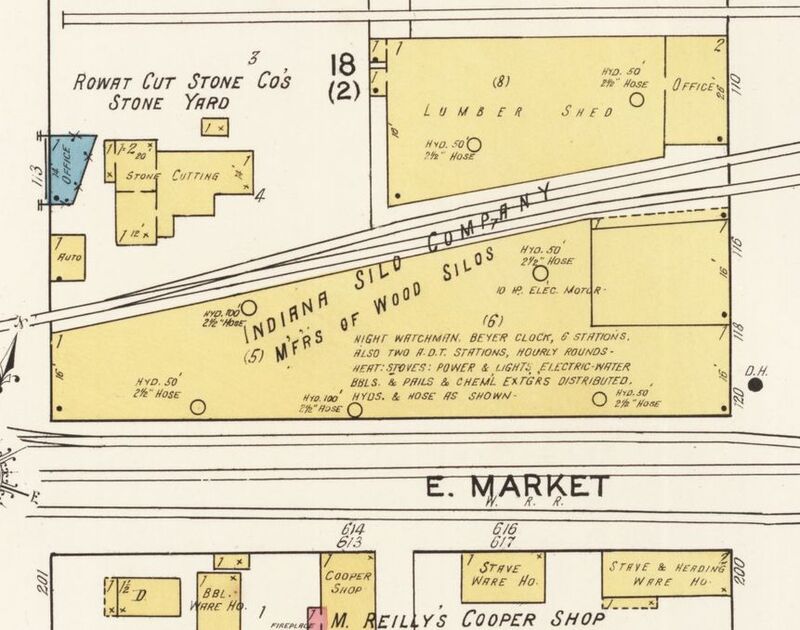
Rowat Cut Stone Co.
Color Sanborn fire insurance map showing location of Rowat Cut Stone Co.'s stone yard between Market and Vine Streets on SE 6th. Separate building is noted as an office. Located north and east of Indiana Silo Company. | Source: Sanborn Fire Insurance Map from Des Moines, Polk County, Iowa. Sanborn Map Company, Vol. 2 | Date: 1920
White Milled Stonework
Photograph of milled stonework. Caption provided: Pictures show finished stone and how the milling machine helped in cutting this stone. | Source: History of the Rowat Cut Stone Co. | Date: 1924
Cottage Grove Avenue Presbyterian Church
Photograph of Cottage Grove Avenue Presbyterian Church located at 1050 24th Street, Des Moines, Iowa.. | Source: History of the Rowat Cut Stone Co. | Date: 1917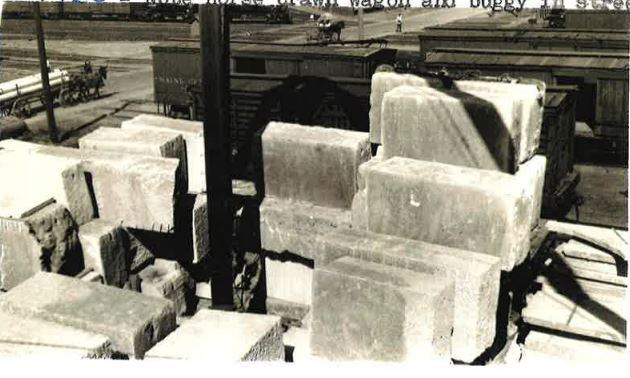
Rowat Cut Stone Co. Stoneyard
Photograph of stone slabs with train cars and horses pulling wagons in bacground. Provided caption: Note horse drawn wagon and buggy in street. | Source: History of the Rowat Cut Stone Co. | Date: 1920
Rowat Cut Stone Co. Display Booth
Photograph of the Rowat Cut Stone Co. display booth at Buildings Show in the old Coliseum. | Source: History of the Rowat Cut Sone Co. | Date: 1925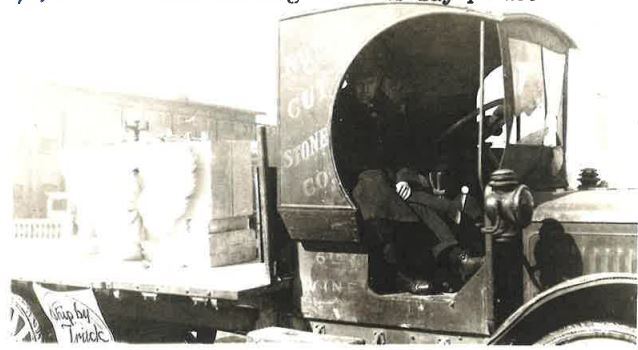
Rowat Cut Stone Truck with stone carvings on the flatbed.
Photograph of two men in Rowat Cut Stone Co. Truck, no doors. Provided caption: This carving in Labor Day parade. | Source: History of the Rowat Cut Stone Co. | Date: 1922
Rowat Cut Stone Co.
Photograph of building with large slabs of stone next to Wooden building has large sign: Rowat Cut Stone Co. E. 6th and Vine. | Date: 1917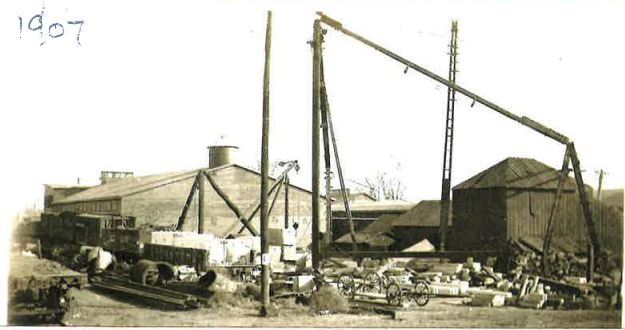
Old Wood Derrick
Photograph of old wooden derrick, Rowat Cut Stone Co. This derrick had previously been used while building the Iowa State Capitol. | Source: History of the Rowat Cut Stone Co. | Date: 1907
Steel Derrick
Photograph of steel derrick surrounded by large slabs of stone, Rowat Cut Stone Co. | Date: 1922?
Steel Derrick
Photograph of Rowat Cut Stone Co. steel derrick with large slabs of stone, as well as two trucks. Railroad tracks run along bottom left side. | Source: History of Rowat Cut Stone Co. | Date: 1928?
Men who worked on Iowa State Capitol Building
Photograph of men standing around large slabs of stone. All men unidentified except one. Caption: Picture shows some of the men who worked on the Iowa State Capitol Building. Arrow points to John Rowat. | Source: History of the Rowat Cut Stone Co. | Date: 1872 - 1886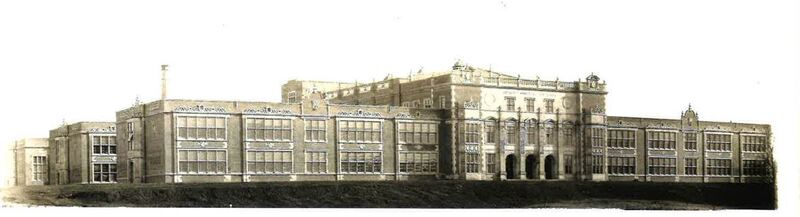
Theodore Roosevelt High School
Image of the front facade of Theodore Roosevelt High School, Des Moines, Iowa. | Source: History of the Rowat Cut Stone Co.
Abraham Lincoln High School
Image of the front facade of Abraham Lincoln High School, Des Moines, Iowa | Source: History of the Rowat Cut Stone Co.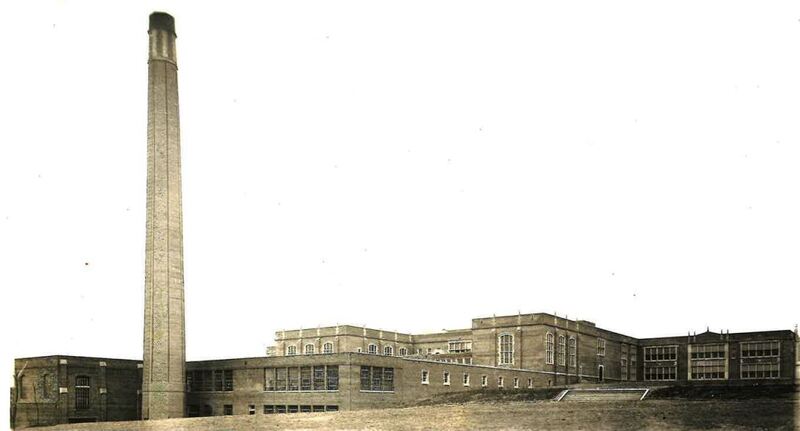
Abraham Lincoln High School
Back facade of Abraham Lincoln High School, Des Moines, Iowa. | Source: History of the Rowat Cut Stone Co.
Bankers Life Company
Photograph of construction of the Bankers Life Company building. Provided caption: 1959 Bankers Life addition. | Source: History of the Rowat Cut Stone Co. | Date: 1959
Cut stone for the towers of St. Cecilia Catholic Cathedral
Cut stone pieces for St. Cecilia Catholic Cathedral cupolas. Provided caption: In 1958 we cut the stone for the top of the two towers on the Catholic Cathedral in Omaha, Nebraska. | Source: History of the Rowat Cut Stone Co. | Date: 1958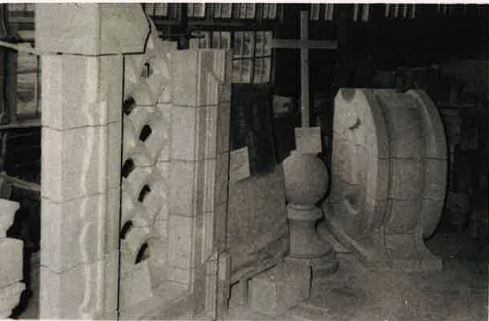
Cut stone pieces for St. Cecilia Catholic Cathedral towers.
Cut stone pieces for St. Cecilia Catholic Cathedral towers. Provided caption: In 1958 we cut the stone for the top of the two towers on the Catholic Cathedral in Omaha, Nebraska. | Source: History of the Rowat Cut Stone Co. | Date: 1958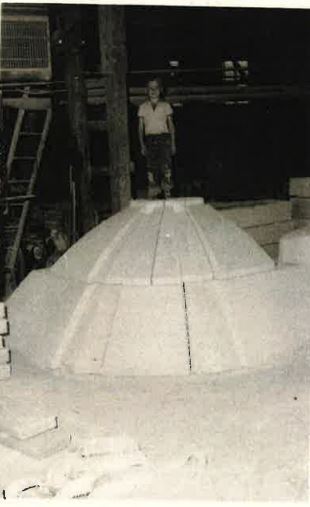
Cut Stone Cupola Top
Cut stone cupola top for St. Cecilia Catholic Cathedral towers. Jeff Rowat, grandson of Thomas W. Rowat, standing on top. Provided caption: In 1958 we cut the stone for the top of the two towers on the Catholic Cathedral in Omaha, Nebraska. | Source: History of the Rowat Cut Stone Co. | Date: 1958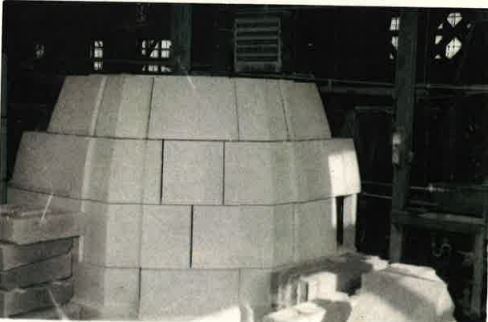
Stone Cut Cupola
Partially completed cut stone cupola for St. Cecilia Catholic Cathedral, Omaha, Nebraska. Provided caption: In 1958 we cut the stone for the top of the two towers on the Catholic Cathedral in Omaha, Nebraska. | Source: History of the Rowat Cut Stone Co. | Date: 1958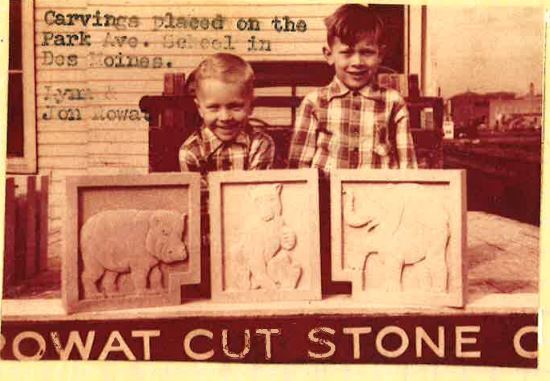
Lynn and Jonathan Rowat with Carvings
Lynn Rowat and Jonathan Rowat, grandsons of Thomas W. Rowat with three stone bas-relief carvings: Hippopotamus, bear, and elephant. Provided caption: Carvings placed on the Park Avenue School in Des Moines. | Source: History of the Rowat Cut Stone Co.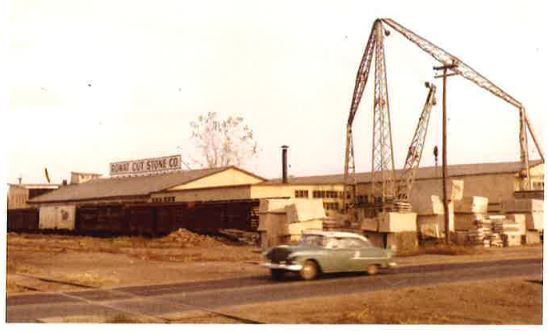
Rowat Cut Stone Co.
View of Rowat Cut Stone Co. | Source: History of the Rowat Cut Stone Co. | Date: 1959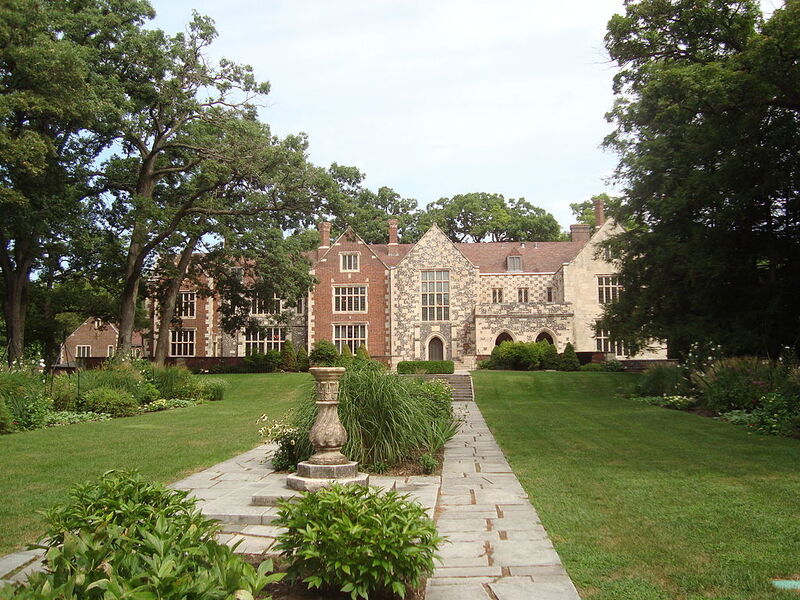
Salisbury House
Photograph of the Salisbury House from the gardens, Des Moines, Iowa | Source: WikiMedia Commons | Date: 2011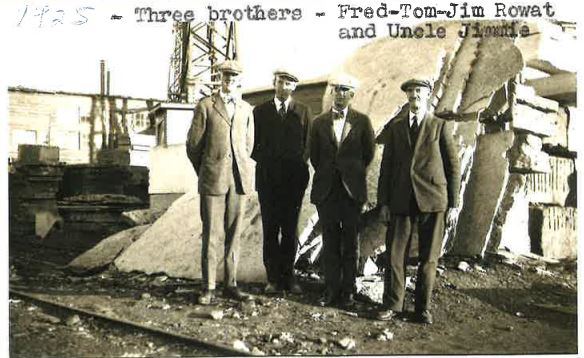
Fred Rowat, Tom Rowat, Jim Rowat and "Uncle Jimmie"
Four men in suits and hats standing front of stone slabs. Provided caption: Three Brothers - Fred - Tom - Jim Rowat and Uncle Jimmie. | Source: A History of Rowat Cut Stone Co. | Date: 1925